AN EXPANDING SURVEILLANCE INFRASTRUCTURE
The Argentinian government has procured various surveillance technologies, including open-source intelligence platforms designed for the collection, cross-checking and visualization of large volumes of data from social media, websites, the dark web, personal data, technical infrastructure and other public databases.
Purchases also include licences for facial recognition software from companies with a track record of mass exploitation of biometric data without sufficient legal grounds , as well as the procurement of drones and ground control stations, with automated tracking capabilities, thermal cameras and real-time transmission of images.
“We’ve all been fully identified for a long time now… Sometimes as you’re walking you get to [where you were going] and suddenly you see the drone hovering just above your head. Sometimes within six feet. Why so close? Why is it so invasive?”
– Ana Tapia, a member of the Insurgent Pensioners (Jubilados Insurgentes) collective.
Pensioners in Buenos Aires march every Wednesday to the National Congress to protest against the pension cuts made by the national government.
Amnesty International’s research demonstrated the direct impact such surveillance capabilities are having on various groups including journalists, activists, and migrants.
It found that some were self-censoring on social media and in public spaces, reducing participation in protests for fear of being identified and targeted, and taking more cautious measures in the planning of public activities.
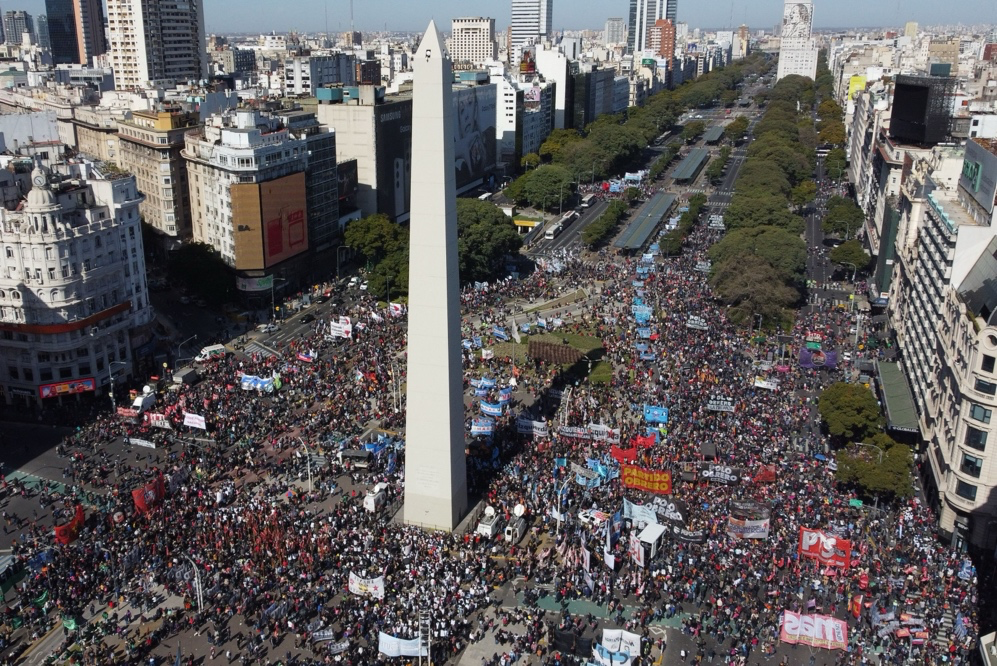
INVESTIGATING THE IMPACT OF SURVEILLANCE IN BUENOS AIRES
Amnesty International conducted interviews with 21 people including journalists, activists, pensioners, young people and human rights defenders, and analysis of scores of procurement documents and data related to acquired surveillance technologies obtained through freedom of information (FOI) requests.
In addition, Amnesty International, together with local human rights organizations, held a hackathon in October 2025, during which the coverage of surveillance cameras located in the vicinity of the National Congress and the Avenida 9 de Julio, was established to measure the risk of exposure to facial recognition technologies. The map is highlighted below, and the procurement data can be viewed in the full report.
BAN AI-DRIVEN MASS SURVEILLANCE; PROTECT HUMAN RIGHTS
Around the world, states engaged in authoritarian practices are ramping up their use of surveillance technologies against human rights defenders, young people, migrants, marginalized and displaced groups, and dissidents. This goes hand in hand with a lack of oversight, transparency, and accountability
Amnesty International is calling on the Argentinian authorities to ban the development, production, sale, and use of remote biometric recognition technologies for mass and targeted discriminatory surveillance, and to ban its unlawful use by all public and private actors.
The authorities must also establish appropriate regulatory measures for the procurement, development, production, sale, import and export of surveillance technologies, and specific public policy frameworks for their use.